Exogenous Ketones!

Wednesday, February 18, 2015

THE VIKING MANIFESTO Part 5: Muscle Fiber Types, Recruitment and Specificity

THE VIKING MANIFESTO: Piecing Together a New Approach to Nutrition and Training for Swimmers from Scientific and Anecdotal Evidence.
Part 5: Muscle Fiber Types, Recruitment and Specificity.


bullcrap meter.GIF
At this point, I hope my arguments are interesting enough that you want to read more, but I understand if you feel like this guy. It's a lot to take in.


In the last chapter we focused on energy metabolism within the muscle, paying particular attention to the idea that mitochondrial density, the utilization aspect of the supply vs. utilization argument, is supremely important, and that the ketogenic diet may enhance this metabolic adaptation in athletes.  This would open the door for the LCHF diet making a difference in swimming no matter the race distance.  Today, we are still on the topic of metabolism, but we will also be looking more at the supply side, as well as looking into how it applies to the concept of specificity, which should be at the heart of any athletic training, especially for a sport as training and technique intensive as swimming.

In the past, only ultra-endurance athletes paid much attention to the concept of fat-adaptation, almost as though it was something that really only mattered if you planned to hold steady state for several hours.  Interestingly, a good marathon runner will tell you, you don't have to be "in ketosis" to be fat adapted.  You can actually become somewhat fat-adapted as a carb eater if you work out often enough with long enough workouts to deplete glycogen stores often and force the adaptation, but it will not bring the same level of adaptation.  Obviously LCHF isn’t the only way to go, but I defy you to find a better way to make that adaptation in a person training for a 1-2 minute race.  While swimming has had generations of continuous success with high-carb and long workouts, I am guessing that soon there will be more people training and eating smarter who can have the same or higher levels of success and have more chance at a life outside of the pool.


I am hoping to be one of the pioneers who proves it.  I don’t have time to train even a tenth of what I did twenty years ago, but I am certain I can go faster than I did at what would be considered my “prime” in spite of the twenty year taper I am trying to manage.  I am certain we will start seeing some world class athletes improving and loving the sport for longer careers, and you will see young athletes develop in a new way by training for the most appropriate adaptations, and getting rid of all metabolic interference that they didn’t even realize was standing in their way.  New science is emerging all the time regarding the benefits of carbohydrate restriction. Just check out this finding by Yale University that was released this week. It implies confirmation for me of a lot of the anecdotal evidence I have seen all over web forums regarding things like acne and arthritis improving, as well as with many of the claims made in the low-carb community about heart disease and more.


I found a fantastic write up from the Gatorade Sports Science Institute called Muscle Adaptations to Aerobic Training that I will refer to as a textbook of sorts since they cite the sources that have made these concepts accepted standards. Even without considering diet, I love this as a resource because, while it agrees with a lot of what I have spoken about already regarding mitochondria, muscle capillarity and blood flow capacity, they do a great job of interjecting research findings into their descriptions that enhance our knowledge of the complex interactions between these contributing factors and create a good picture of what a smart training program will look like when we are specific about the adaptations we are striving toward.  I just want to point out and paraphrase a few things from this resource:


  1. MITOCHONDRIA: They make the same points I did earlier about mitochondria increasing aerobic capacity, but they add that it was previously thought that “increased enzymatic capacity was not utilized because mitochondrial content was considered in excess of maximal needs even in untrained muscle, but now there is evidence to indicate that an increase in mitochondrial content is necessary to realize the increased potential for aerobic ATP provision induced in muscle training.”  So basically, once they thought that we naturally had plenty of mitochondria so we should just focus on increasing blood supply to muscles, but now they have backtracked and think mitochondrial enhancement is pretty important because it gets muscle to burn more fatty acids and less glycogen to improve muscle performance.  This is pretty much the point I made in part 4 of the manifesto.  
  2. BLOOD FLOW CAPACITY: Here they say that blood flow to skeletal muscle is so exceptionally high that cardiac output can’t sufficiently perfuse all of the blood vessels in our muscle mass even if they were to maximally dilate.  Thus, even during intense exercise requiring max oxygen consumption, this limitation means that only a fraction of an individual’s entire muscle mass can be active, and then it only functions at a fraction of its blood flow capacity.  Nevertheless there is evidence that the peak capacity of muscle is increased by endurance training, BUT the value of this adaptation that further increases the ‘unused’ blood-flow reserve in muscles is unclear.  It is likely that the important features of vascular adaptations to training involve the optimal utilization of the flow delivered to the muscle and the exchange of nutrients between capillaries and fibers.  Once again they point toward utilization being the more important factor.  
  3. MUSCLE CAPILLARITY: This is where the two points above come together.  Basically, they say that exercise training increases the number of capillaries surrounding individual muscle fibers, so when a fiber is recruited it becomes more effectively “bathed” in the flow of blood delivered to the muscle.  This development of increased capillarity can occur in all fiber types but is most easily observed when improved in low-oxidative fiber and can contribute to total max oxygen consumption.


Low-oxidative muscle fibers? Now we are getting somewhere. This brings us to another one of those extremely important concepts in exercise science that many coaches have not been versed in:  muscle fiber types 1, 2a and 2b (which the fantastic description I cut and pasted below from athletics.wikia.com calls type 2x.) Many coaches talk of fast-twitch and slow-twitch, but may not quite have their head grasped around the fact that we are considered to have two types of fast-twitch muscle fibers and the difference between the two might just be one of the most important physiological aspects related to training in the sport of swimming.  Here is the run-down on fiber types so we know you are up to speed:


Type I
Type I muscle fiber is also known as "slow twitch oxidative" fibers. Muscle fiber types can be broken down into two main types: slow twitch (Type I) muscle fibers and fast twitch (Type II) muscle fibers Type I fibers are used in lower-intensity exercises such as very light resistance work aimed at muscular endurance and long-duration aerobic activities such as 5K and 10K runs. Type I fibers are identified by slow contraction times and a high resistance to fatigue. Structurally, they have a small motor neuron and fiber diameter, a high mitochondrial and capillary density, and a high myoglobin content. ST fibers also have a low supply of creatine phosphate, low glycogen content, and a high store of triglycerides (the stored form of fat). ST fibers contain few of the enzymes involved in glycolysis, but contain many of the enzymes involved in the oxidative pathways (Krebs cycle, electron transport chain).  ST fibers are predominantly used for aerobic activities requiring low-level force production, such as walking and maintaining posture, but are also the primary fiber type found in endurance athletes. Most activities of daily living use ST fibers.
Type II
Type II muscle fiber is also known as fast twitch muscle fibers. These fast twitch fibers can be further categorized into Type IIa and Type IIx fibers,  which are also known as "fast twitch oxidative" and "fast twitch glycolytic," respectively. Type I fibers are characterized by low force/power/speed production and high endurance, Type IIx fibers are characterized by high force/power/speed production and low endurance, while Type IIA fall in between the two. It is possible that a fiber might be transformed from Type IIx to Type IIA with exercise training.

Type IIA

Type IIA fibers (Fast Twitch 1), or fast oxidative fibers, are used more during sustained power activities such as sprinting 400 meters or doing repeated lifts with a weight below maximum (but not with very light weights). They contain very large amounts of myoglobin, very many mitochondria and very many blood capillaries. Type IIA fibers are red, unlike Type IIx fibers, which are white. Type IIA fibers have a very high capacity for generating ATP by oxidative metabolic processes, and split ATP at a very rapid rate. They have a fast contraction velocity and are resistant to fatigue. Such fibres are infrequently found in humans.
Type IIx Fibers
Type IIx fast-twitch fibers (Fast twitch 2), or fast glycolytic fibres, are recruited for very short-duration high-intensity bursts of power such as maximal and near-maximal lifts and short sprints. Type IIx fibres contain a low content of myoglobin, relatively few mitochondria, relatively few blood capillaries and large amounts glycogen. Type IIx fibres are white, while Type I (slow twitch) fibers are red. Type IIx fibers are geared to generate ATP by anaerobic metabolic processes, however, they are not able to supply skeletal muscle fibres continuously with sufficient ATP, and fatigue easily. Type IIx fibers split ATP at a fast rate and have a fast contraction velocity. Such fibres are found in large numbers in the muscles of the arms.


Now back to the page from the Gatorade Sports Science Institute:


Please allow me to cut, paste and paraphrase a few things from their section on Training Stimulus:  it is clear that the muscles (or fibers within a muscle) not involved in the exercise task do not adapt.  Thus, the critical stimulus for adaptation is something very specific to the active fibers and not likely to be some generalized factor circulating in the blood that influences all muscles.  Further, for a given exercise program, training must be performed for a sufficient duration of days or weeks to allow the muscle-specific biochemical adaptations to reach steady-state.  For example, mitochondrial content appears to reach a steady-state after approximately 4-5 weeks of training.


The magnitude of the training-induced increase in mitochondrial content is also influenced by the duration of the daily exercise bout.  Longer exercise bouts generally produce greater increases in mitochondrial content.  However, the influence of exercise bout duration is not linear, as training sessions become increasingly prolonged, the additional training time appears to be relatively less important as a signal inducing an increase in mitochondrial content.  Further, exercise intensity interacts with the duration of the exercise bout to make the initial minutes of exercise even more effective in establishing a stimulus for adaptation.  Note in figure 2 that the peak adaptation in mitochondrial content seems to occur with shorter durations of exercise as the intensity of each training bout is increased.  The benefit of very prolonged training sessions in enhancing performance may be related to adaptations in cardiovascular function, fluid balance substrate availability, or other factors not directly related to muscle-specific adaptations. At least part of the beneficial effect of increasing exercise intensity on training induced adaptations in muscles can be attributed to the effect of intensity on muscle fiber recruitment.  


Let that sink in for a second. All of the above basically makes the case that the high-volume traditional swim training that we all grew up with is old-school, and that if we want a better adaptation we can shorten up the workouts and just make them more intense. They also make the point that seeking a “general” fitness adaptation is a waste of time because muscle fiber recruitment is specific and muscle fibers not specifically recruited for an activity don’t adapt. The longer exercise bouts inherently involve lower intensities, and thus would be effectively adapting slow-twitch fibers to be more efficient at metabolizing oxygen.  Remember, slow-twitch fibers cannot become fast-twitch and fast-twitch cannot become slow-twitch.  The only change of muscle fiber type we can make is from fast-twitch oxidative to fast-twitch glycolytic and vice-versa-- so, essentially, high-intensity trumps long-distance training in regard to utilization and supply, since mitochondria increase with intensity AND as stated above in the section on muscle capillarity: development of increased capillarity can occur in all fiber types but is most easily observed when improved in low-oxidative fiber and can contribute to total max oxygen consumption.

Therefore, I contend that if we want to improve supply and utilization both, we should focus on high-intensity swimming done in a way that is designed to cause type 2b muscle fibers to convert to type 2a, and the LCHF diet is the key to unlocking a higher level of potential if we can train for this specific adaptation along with it.  Maximum power drawn aerobically, with the most efficient glycogen sparing possible to save anaerobic glycolysis for only the highest intensities at the end of the race.  


Whoa.  Damn… apparently, I wasted a lot of time training the speed right out of me back in the day.  I never did get any good at that 1200 IM I was training for either.  Hmmm…. Ever get the feeling you’ve taken some kids and done that to them?  I know I have felt that way with a few of my most talented.  I have a couple of former athletes I wanna talk back into the water when they bring their 4 year olds to sign up for our swim lessons program, and a few more I want to apologize to for just for wasting so much of their time.  Yup, coaches…  I said it.  I admit that I wasted their time by just swallowing what I was taught and not researching it for myself.


bang head on fence.GIF


The next chapter will be about the way we should train for the absolute best adaptations to translate to effective racing within the rules of the Viking Method.  I am sure that many of you SwimSwam commenters can guess where I am heading with this.  Time to break out the flame-throwers, y’all.  There’s gonna be a lot of acronyms coming your way.


IMG_4103.GIF

Please, don’t hold back on the comments.

Monday, February 16, 2015

THE VIKING MANIFESTO Part 4: LCHF and Energy Metabolism Within the Muscle

THE VIKING MANIFESTO: Piecing Together a New Approach to Nutrition and Training for Swimmers from Scientific and Anecdotal Evidence.
Part 4:  LCHF and Energy Metabolism Within the Muscle


In part 3 I explained that while VO2 max may be important, focusing training on raising anaerobic threshold to maintain longer durations at high intensities that are close to VO2 max would probably yield more applicable results. I then presented research that implies that a low carbohydrate, high fat diet can help improve this aspect of aerobic conditioning, even in already extremely fit athletes, by making fat a more available and faster burning fuel.  Now I intend to show that the implications for adaptation to the LCHF diet go beyond long-distance swimming at low intensity levels.  

To do this, I must start with some of the perceived limitations to the LCHF diet and why they might not be limitations at all.  

First, I have to make you aware that many people who train with the low carb high fat diet believe that with keto there is a loss in VO2 max and peak power, as though keto-adaptation only serves to improve lower intensity activities and can hinder fast twitch or high-power activities.  This has been backed up in some studies, but it is questionable whether those studies allowed proper conditions to truly know whether this is the case or not.  There are world class triathletes out there who have a train-low/race-high philosophy regarding carbohydrate, simply because they want the adaptations associated with LCHF but want to avoid the limitations associated with glycogen stores not being refueled on race day.  That makes sense, I guess, except that an insulin spike and full liver glycogen stores can stand in the way of ketosis, which I think would be a disadvantage on race day.  Dr Attia actually endorses a product called Generation UCANN, which is what they call a “super-starch”: an extremely low glycemic carbohydrate gel that can feed an athlete carbs without the insulin spike.  It is also known that eating small amounts of non-fructose carbs after exercising hard (creating a glucose deficit) will immediately go toward refueling muscle glycogen first, rather than toward fat storage or replenishing liver glycogen, meaning that you can use your workload to calculate how many carbs you can eat without interfering with ketosis at all.  I don't bother with all that, but there is also some speculation that the little bit of carbs I do eat, in conjunction with the protein amounts I eat which are higher than the typical ketogenic dieter, might be refueling muscle glycogen to some degree anyway since my training load is so low. Ketogenic dieters often try to keep protein intake low so that gluconeogenesis, (creating glucose from proteins,) does not stand in the way of their weight loss.  There is evidence that while a high protein meal might reduce ketosis temporarily, it doesn’t necessarily stand in the way of the adaptations I am looking for, as it is most likely the calories taken in that cause lower ketone measurements after meals, and the protein has other benefits in regard to training that are a good trade-off for athletes.

I am not sure I buy into the whole idea that we need carbs for peak performance and I certainly feel that more science needs to be done.  I don't have specific measurements so my experience is completely anecdotal, but I have never felt better at high intensities than I do now that I eat extremely low carb. Of course, I have been adapted for over a year and a half, and so far no study has even approached this-- especially one with swimmers. I tend to lean toward an almost completely carnivorous diet and I think my results are better when I cut out nearly everything but animal products.

IMG_3936.JPG
My wife hates ordering at the drive-thru with me in the car.

There is evidence that with proper adaptation we might not lose that peak power that everyone is so worried about.  Remember those two adaptations that we are training for: increased blood-flow and oxygen supply through capillarity and increased mitochondrial density within muscle cells?  Well, mitochondrial density just might be the main reason the LCHF diet can give us such a boost and it ties directly into being able to churn out high intensity exercise.

Enter Dr Bill Lagakos.  He is a guy who likes to tweet, and occasionally his tweets are links to recent research regarding health, along with write ups to help the layman understand their findings and implications. Dr Lagakos did a write up about two studies recently that showed increased mitochondria in mice with a switch to LCHF, and these adaptations came about within a few weeks. The best part-- these adaptations came about with no additional exercise.  They did not torture these mice on a treadmill.  This means that the diet prompted increased mitochondria on its own.  Could it be that high fat prompted this response, or could it be that carbohydrate was previously holding this natural potential back?  Take a look at it yourself. According to Dr Lagakos, it “increased mitochondrial everything.”  

mighty-mouse.jpg
Most mice are herbivores.  Get them away from the vegetarian thing and look what happens.

This is a very interesting finding.  In that post, Dr Lagakos makes the analogy that if glucose were gas and mitochondria were hoses, then ATP would be the rate at which you can fill your tank.  He then compares fat to this by likening it to trying to draw syrup from a tree with a spout. Remember how much ATP fat can generate compared to glucose from earlier in my manifesto?:  129 molecules from some fats vs only 2 molecules from glucose...  Keep that in mind when reading as he theorizes: “So how would you get your bucket filled with syrup faster?  Try “more spouts.”  And reduce the viscosity of your maple syrup by diluting with some ketones.  More than 3 weeks on a ketogenic diet and you have more better mitochondria and can generate ATP just as fast as high carb.”

Here Dr Lagakos points at a few more studies.  One is from the 1980’s and shows the same improvement in aerobic capacity along with lower RQ that Dr Attia found in his self-experimentation, but this study also includes some athletes whose VO2 max scores improved as well. (Remember how I pointed out that we should focus on improving anaerobic threshold since it is so difficult to improve VO2 max in well trained athletes?  Hmmm…  this indicates that for some we might see an increase in VO2 max as well.)  Of course, Dr Lagakos is basing his findings partly on studies with mice.  We haven’t had a study that shows this phenomenon of increased mitochondria in us that I know of, and we are obviously not mice, but it would sure explain some of the unique attributes of fat-adaptation.  Mark Sisson, a leader in the paleo community, wrote a wonderful article about mitochondria that speculates on this as well, but I encourage you to read it at this link because it goes into a lot more detail about what mitochondria actually do and how we can maximize them through exercise and diet, and his recommendations are pretty much along the same lines.  He even implies that healthy mitochondria can have an anti-inflammatory effect, which is one of the surprise side-effects that continuously pops up on ketogenic diet forums on the web.

It gets even more intriguing though, as Dr Lagakos also points toward two somewhat recent studies showing no loss of peak explosive power in well-trained athletes who switch to LCHF. The interesting thing here in the first study is that the gymnasts being tested lost body weight but lost no power, which improved their body composition with no sacrifice.  This would be valuable in most sports. The other study though, covered a broad range of tests of peak power: handgrip, vertical jump, max bench, back squat, max rep bench press power output, and the Wingate, which is the one that makes me drool the most. (Here's a video of the Wingate.  Damn that looks hard.)  There are of course theories about why these positive results might go against the standard thinking:  the weight loss from the diet might have made these athletes seem more powerful in comparison, or that eating extra protein might have had a “trickle charger” effect by forming sufficient glucose through gluconeogenesis, which could explain why I feel as I claimed above, better than ever at high intensities.  Also based on study design we could guess that peak power isn't diminished with LCHF "given enough recovery time" but more science will need to be done to get a full explanation. This concept intrigues me only because my schedule doesn’t allow for me to train as often as I would like, which would actually contribute to this effect for me and could be diminished in a more hard-core athlete.  I am certainly not needing to manage cumulative fatigue the way I did under my traditional training regimen twenty years ago as I am getting plenty of time to recover between workouts, even though it is not necessarily because I want it that way.

il_340x270.541115471_16aj.jpg
Hey, making a comeback at age 40 just requires a little extra rest, ya know?!

One thing that is clear though is that well-trained athletes seem to be able to flip the metabolic switch more quickly, which might have something to do with these studies of short duration showing improvements that imply successful fat-adaptation, and this is probably because someone who is in shape is much less likely to have developed a high level of insulin resistance to overcome. (The majority of studies on the ketogenic diet focus on weight loss and thus have subjects who are obese.)  Again, more research needs to be done with well trained athletes who are fat adapted for long periods of time to answer these questions.

The point is that increased mitochondria might be just as valuable as capillarity, even though it is typically accepted that in regard to vo2max, supply (capillarity) is considered more important than utilization (mitochondrial density.)  Of course, once again, when we get into the question of whether VO2 max is an important indicator of success in elite swimming.  A better formula for success might be: Technical efficiency and speed at the intensity as close as you can possibly hold to your VO2 max, for the specific distance of your intended race without the negative impact of lactate clearance not keeping up with production. VO2 max is really only a small part of that equation.  Again, more detail on that later.

Next we get into specificity.  Hold on to your helmets.


Thursday, February 12, 2015

THE VIKING MANIFESTO Part 3: LCHF and Aerobic Capacity

THE VIKING MANIFESTO: Piecing Together a New Approach to Nutrition and Training for Swimmers from Scientific and Anecdotal Evidence.
Part 3:  LCHF and Aerobic Capacity


In part 1 I gave you a summary of some general nutrition advice that seems to contradict most of what we have been taught all our lives.  In part 2 I laid out some of the science of swim training in relation to the energy zone descriptions recommended by USA Swimming.  This time, it starts to become about how a low-carb, high-fat LCHF diet matters to you, the swimmer or swim coach.  


tumblr_mrbqs8uGza1s9qf9ro1_500.gif
Yup, this is kind of what researching for my manifesto felt like.


When I first started burrowing down the rabbit hole on this topic I saw unbelievable pictures of overweight and obese people who said they had tried everything and this was the first thing that ever worked to help them lose weight and keep it off.  I saw a lot of posts from body-builders who claimed they could gain muscle and get lean by eating fat.  I saw a lot of pictures of bro's from the gym showing off their progress and heard lots of stories about how everyone else at the gym (as well as their doctors) thought they were idiots until the progress in body composition and lipid profiles were obvious. The anecdotal evidence was overwhelming, and the science they presented and dissected was fascinating.
Then I stumbled across this guy: Dr. Peter Attia was a boxer who roomed with a swimmer at Stanford during medical school.  He fell in love with swimming and started training for triathlons and open water swims, and writes an absolutely obsessive blog about his quest to stay in near permanent ketosis.  He is also one of the founders of NUSI, an organization determined to perform a lot of the studies to answer nutrition questions no one has attempted before. There’s a lot of bad science out there and he wants to do something about it.  Watch this video of Dr. Attia to learn more than you ever wanted to know about the ketogenic diet.   


Go ahead, search for LCHF and/or ketogenic triathletes and runners on the google.  Come back when your mind is blown.  Swimming is way behind the times when it comes to stuffing our faces properly.


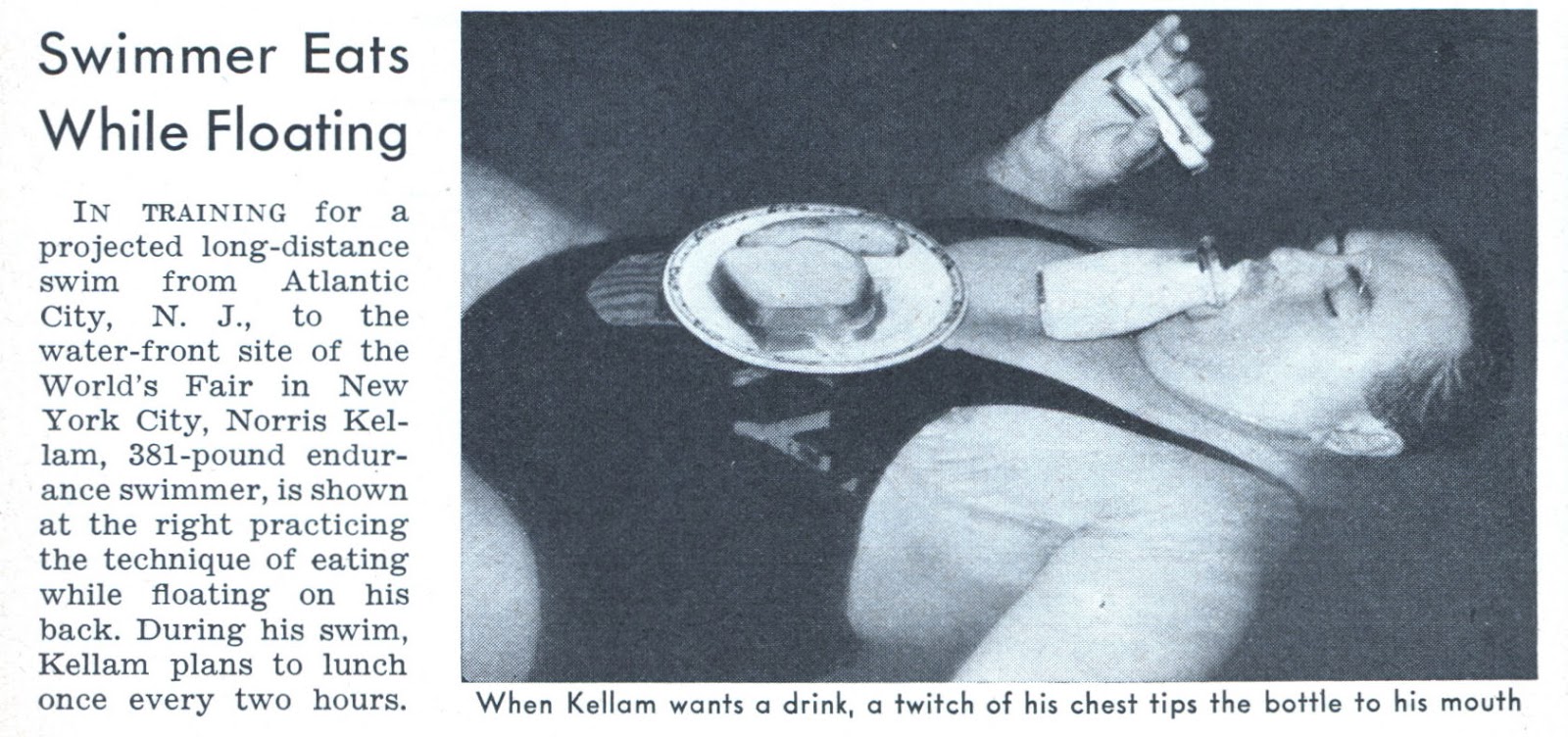
floating_eating.jpg
Well… except for this guy.  He’s got it figured out.  Wait!... Is that John Leonard? And is he wearing an illegal suit?!


During the height of the Atkins phase there were probably a lot of active people who jumped on board the low carb bandwagon and within a few weeks decided that it was a horrible idea for athletes.  This is due to two things:  first, when reducing carbohydrate we stop retaining the same amount of water, which means that we also flush electrolytes and can end up with flu-like symptoms if we do not manage this correctly; and second, there is an adaptation time that is required to start seeing the benefits of burning fat as your primary fuel. As a sugar-burner, I did not use fat as a fuel as efficiently, but now that I am a fat-burner I still have no problem burning sugar as fuel any time with no adaptation time required.  You see, there are changes that need to happen within the muscle, within cells, to be able to efficiently burn fat and ketones as fuel.  Reducing carbohydrate allows us to take better advantage of a higher level of metabolic flexibility.


Part of the problem with the currently accepted science regarding athletic nutrition is that when it comes to any studies that measure whether carbohydrate or fat is a better source of energy, fat tends to be set up to fail.  Studies can claim to be low carb while still allowing up to 30-50% of energy intake as carbohydrate (since the standard diet contains a ridiculous 70% carbs,) which does not allow for the metabolic switch to be flipped properly.  It can actually be a recipe for disaster in health since a diet that is both high carb and high fat has proven to be the best way to develop heart disease, especially when much of the fat in the standard American diet is from easily oxidized polyunsaturated vegetable oils or trans fats. Also, very few studies have been done that have allowed proper time to adapt and gain the metabolic flexibility to truly find the answers to many of the most important questions related to sports performance. Most of the studies out there would seem to imply that carbohydrates are not just a superior fuel, but that cutting them out is guaranteed to make performance suffer.  Unfortunately, the textbooks tend to agree.


Ad-icon-battle-Smokey-Bear-vs-perky-Flo-GQCBUS1-x-large.jpg
Smokey says: “Screw it.  Burn those stupid books.  They got it all wrong.”


Ever heard of Dr Tim Noakes?  He wrote a book called The Lore of Running and there are virtually zero serious runners out there who have never read it.  He was a world-class endurance runner in his day and is one of the leading researchers in athletics.  He is one of the guys who helped make “carbohydrate loading” a well known concept, among many other very important areas of research in which he has been a respected leader.  Recently, Dr. Noakes has taken some heat for changing his mind in a big way.  He is now telling people “If you’ve got Lore of Running, tear out the section on nutrition.”  He now endorses a low carb, high fat diet.   It takes a big man to admit you were wrong, but this guy followed modern research and came to the conclusion that we should all be eating fat rather than carbohydrate as our primary fuel, and as outlined in part 1 of my series, it is not just for sports.  It is for digestive, cardiovascular and neurological health as well.
Remember, moving anaerobic threshold and VO2 max up the hill has been the main focus of most traditional swim training for decades.  The majority of the work we have always done is in the EN1/2/3 boxes on the chart and is done with the hope of improving blood flow capacity and mitochondrial density.  Basically, we want to supply more fuel through efficient blood supply and provide more receptors through which to burn it.  Here are some additional details on VO2 max from sport-fitness advisor, and if you visit the website it links to additional sources as well:
The fitter an individual is to begin with, the less potential there is for an increase (in VO2 Max) and most elite athletes hit this peak early in their career. There also seems to be a genetic upper limit beyond which, further increases in either intensity or volume have no effect on aerobic power. This upper limit is thought to be reached within 8 to 18 months.
Crucially, once a plateau in VO2 max has been reached further improvements in performance are still seen with training. This is because the athlete is able to perform at a higher percentage of their VO2 max for prolonged periods. Two major reasons for this are improvements in anaerobic threshold and running economy.
So basically, once you hit your “genetic cap” for VO2 max, most improvements you see beyond that have more to do with technique efficiency and with being able to improve the anaerobic threshold to spend more time at an intensity level close to that max without locking up due to generating lactate above what you can clear.  This is important to understand in regard to training.  Basically, VO2 max is a measurement of potential, but anaerobic threshold tells us how much of that potential we can effectively apply to endurance racing.


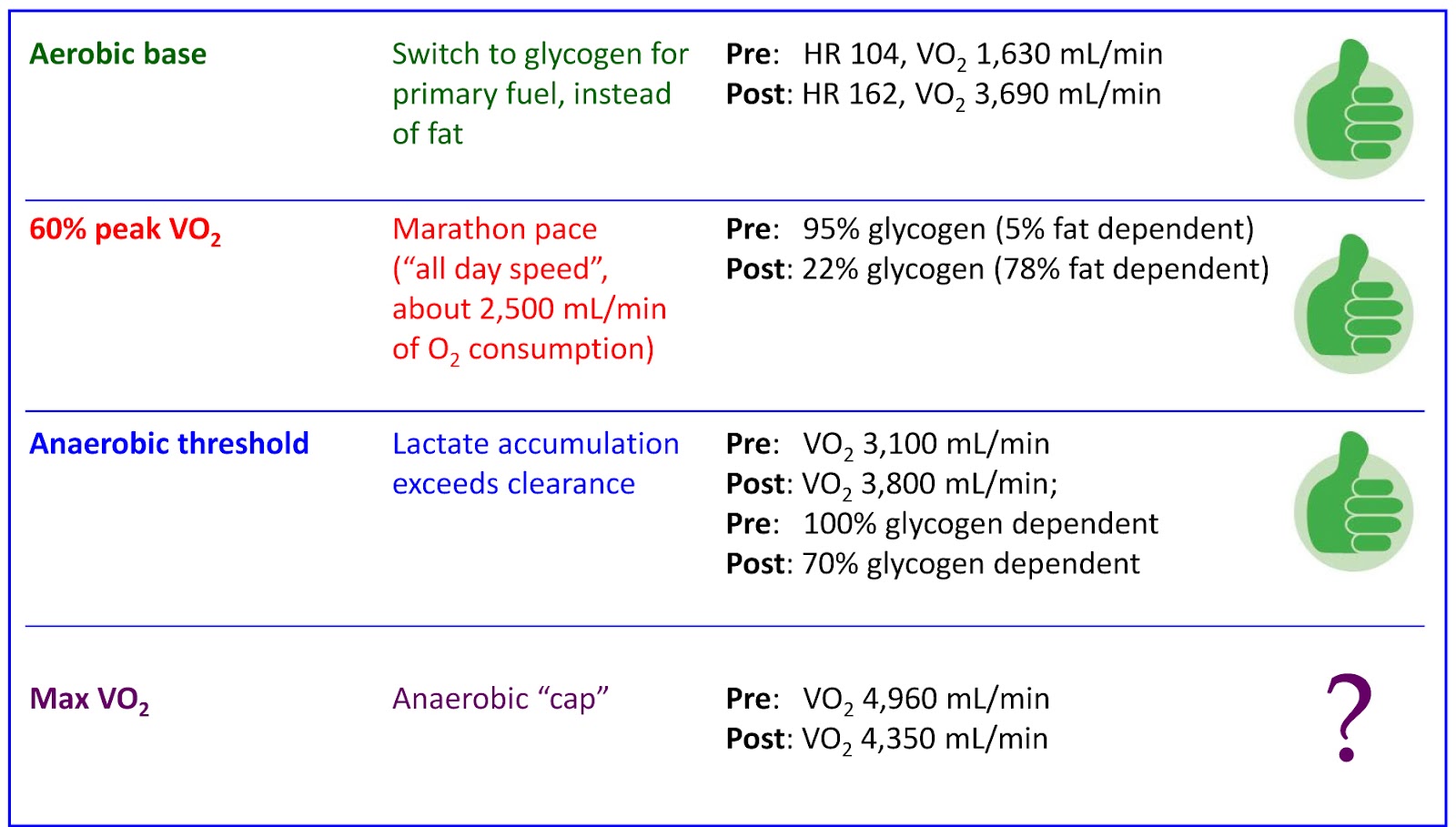
Remember Dr. Attia from above?  Well, when he started his blog, he posted this about the benefits he has seen since switching to a ketogenic diet.  Keep in mind, this is a doctor who was well-trained in endurance sports and had been meticulously tracking his stats before he switched his meal plan. This is not your mom trying her first “couch to 5k.” Note the improvements at the first three levels, which are the most pertinent to aerobic training in light of the information given above.


AttiaSummary1.jpg
Isn’t this the exact adaptation we should be focusing on?  These improvements are significant.  


Part of the reason for these advances might be that the ketogenic diet brings on a “glucose sparing” effect, meaning that even though a person might be training to prime their muscles to burn fat, and are probably storing less glycogen in the muscles and liver because of the carbohydrate restriction involved, we can use so much less glucose while racing that we still have it there for that max power at the end of the race when we need it.  To fully appreciate that this might be possible, I need to introduce you to the concept of Respiratory Quotient, or RQ.  I have cut and pasted the description from Dr Attia’s website, as I contend that this is quite possibly more important to endurance training than VO2 max:  


The respiratory quotient, or RQ, is simply the ratio of carbon dioxide you produce to oxygen you consume.  This ratio typically varies from about 0.70 to just over 1.00.  Why it’s important and helpful to know this ratio is that you can infer, based on the ratio, what you are utilizing for energy (i.e., how much fat versus glycogen) at any point in time during the test:
  • When RQ is 0.70 (i.e., when you breathing out 70% as much carbon dioxide as you are consuming oxygen), you are effectively getting all of your energy from fat.
  • When RQ is 1.00 (i.e., when you are breathing out an equal amount of carbon dioxide to the amount of oxygen you consume), you are effectively getting all of your energy from glycogen.
The goal of any endurance athlete is to derive as much energy as possible from fat, rather than glycogen, for a given level of exertion.  Why? We can store about 1,200 to 1,600 calories worth of glycogen versus 100,000 calories of fat.  Furthermore, replacing glycogen during training/competing is full of problems.  Hence, you want to “spare” glycogen for only those times when it is essential (i.e., when you are anaerobically active) and use fat as much as possible when you can afford to (i.e., when you are aerobically active).
The implications for improving our RQ score should seem obvious for distance swimming and endurance training, since relying less on glucose for work at the same intensity could be tremendously valuable.  This can help an athlete to work harder with less contribution from anaerobic glycolysis, and may have something to do with the claims of “never bonking,” better lactate clearance, and better recovery that many low-carb athletes swear by.   Take a look at Dr Attia’s chart again-- it is obvious that his aerobic capacity went up, and that he was generating the same power/intensity while using significantly less glucose. Essentially, he moved his anaerobic threshold, and can spend more time closer to his VO2 max, by manipulating his diet with no other changes.  Remember, he was already well-trained, and then made these improvements completely as a dietary experiment.


Dr. Attia gives us a great N=1 experiment, but other studies out there show that his increase in aerobic capacity and improved RQ are not an anomaly.  As a matter of fact, recent studies that have allowed for adaptation time and that have finally been done with well-trained athletes are confirming new benefits that long time low carbers have been bragging about for decades.  The science is slowly catching up.  The hardest part for me to swallow about all of this when I began following the evidence was that most of us swimmers are not ultra-endurance racers.  Improving low intensity endurance isn’t really that appealing to me as I don’t intend to ever race a mile again in my life-- and you couldn’t make me race a 10k even if it were to escape the zombie apocalypse.
35427dd2-c39a-4bf3-80da-51a2c24f2ab2.jpg
Yes, kids… this is why the Viking keeps a speedo clipped to his backpack. Never know when you are gonna need it.


For this to apply to us 1-2 minute racers, we would still have to be able to show that adaptation to a ketogenic diet will matter at much higher intensities, those that are owned by anaerobic glycolysis, or it just won’t apply to racing all that well. Right?


Enter the UCONN study.  Ben Greenfield is another self-experimenter.  He and a few other hardcore triathletes teamed up with a leading researcher, Dr Jeff Volek at the UCONN Human Performance Laboratory.  They decided to test a whole bunch of stuff to see what changed when extremely fit athletes were given at least 6 months to adapt to a ketogenic diet, which is much longer than most previous studies had ever done.  If you read part 1 and part 2 of Ben’s write up, you will see that they blew some of their stats off the charts.  The most important of those has to do with how quickly we can metabolize fat as a fuel during exercise.  


It has been standard thinking  for decades that fatty acids could only be burned at a maximum rate of about 1g/min.  That was with research done with athletes though, who were not adapted to the LCHF diet.  At that rate, even with the ability to generate so much ATP from fat versus the tiny amounts from glucose that I outlined in the last chapter of my manifesto, the trade off was not good compared to glucose which generates much less but at a much higher rate, unless of course you are only focusing on lower intensity activity.  The study at UCONN demonstrated that when well-trained athletes are given enough time to adapt to a ketogenic diet, that rate can improve to levels far beyond what we thought possible.  As a matter of fact, all of the athletes in the study were above 1g/min for the majority of the study, and some reached peak fat-burning above 1.5 times faster than what we previously thought was the maximum possible.  This is an incredible finding and has tremendous implications for endurance sports.  


So waitaminnit?!... you mean that we generate significantly more ATP from burning fats than we do from burning carbs, and by simply choosing to skip the hashbrowns when I order my steak and eggs I can make fat burn 50% faster?!  Yup.  That’s what I am saying.  Why in the hell would we want athletes in an endurance sport to be tethered to a carbohydrate burning system that is really only intended to help us with the kick at the end?  Yeah…  We have been doing it wrong for a long time, guys.  Follow the science.  Much more on this later.


ir1p8.jpg
Taking carb avoidance to it’s logical conclusion means that the Viking doesn’t even need to do dishes anymore.


To summarize:  there is evidence that the LCHF diet enhances some of the most important adaptations that swimmers strive to maximize during aerobic endurance training.  By priming the body to more efficiently use fat as a fuel for aerobic workload, we can generate more power aerobically, reduce the required contribution from anaerobic glycolysis, spare glycogen for later in a race where it can play a more important supplemental role, and tap into a nearly unlimited fuel tank of stored fat when compared to the small amount of glucose we are able to store in the liver and muscles.


Let that sink in for a bit… you’re gonna need to swallow that bite before I make my next post.  

Interesting Stats at Complete Nutrition

A couple of my athletes have been stopping by a place called Complete Nutrition lately, which seems to be a place that focuses on supplements and meal replacement products for the bodybuilding crowd.  Both of these athletes are beyond high school age and it is nice to see them taking an interest in nutrition.  They have been asking me a lot of questions and bringing up things they are learning as they read up on it.

I got curious about visiting the store because one of those swimmers has been checking in there to get detailed stats on his body composition.  He was actually able to tell me how much his body fat percentage had improved and exactly what his lean mass is.

So I stopped by the store and had mine evaluated.  Now, I can't make an argument for accuracy here, but the last time I had this done was during a school health fair where they bring in doctors and collect stats and hand out flyers for different programs they offer, but it was far enough into my LCHF diet that I had already lost the weight with running and weighed about 171 with around 10 or 11% body fat.  That would put my lean mass at approximately 154 pounds.

Since then (probably over a year) I feel like I look more fit but I had to go to Complete Nutrition to satisfy my curiosity.  The machine they have just requires you to take your shoes off, stand on some foot pads and hold onto a bar with sensors to press with your thumbs.  Apparently it determines your body composition based on electric currents somehow.  Sorry I don't know much about it.

I came away with a sheet that says I weigh 174.7, with 7.3% body fat and 161.8 pounds of lean mass.  This is very interesting to me as apparently I have gained 7 pounds of muscle while only gaining three pounds over-all.  And this is without lifting weights.  At age 40.

...and I keep getting faster too.  This morning after I completed a round of 100 breast targets USRPT style and scored 15+12+6, (a pretty good score considering I just moved my target time down about half a second not too long ago,) I took a 100 easy and then pushed my fastest 100 breast with-out a dive ever.  1:03.0.  Even better, I was out in 29.  For me, that's a big deal. I am feeling pretty good about the spring sectional meet coming up.  I have already seen significant improvements since the pro-am in December and I am pretty sure it will translate to better racing as long as I am healthy when I get there.