Exogenous Ketones!

Thursday, February 12, 2015

THE VIKING MANIFESTO Part 3: LCHF and Aerobic Capacity

THE VIKING MANIFESTO: Piecing Together a New Approach to Nutrition and Training for Swimmers from Scientific and Anecdotal Evidence.
Part 3:  LCHF and Aerobic Capacity


In part 1 I gave you a summary of some general nutrition advice that seems to contradict most of what we have been taught all our lives.  In part 2 I laid out some of the science of swim training in relation to the energy zone descriptions recommended by USA Swimming.  This time, it starts to become about how a low-carb, high-fat LCHF diet matters to you, the swimmer or swim coach.  


tumblr_mrbqs8uGza1s9qf9ro1_500.gif
Yup, this is kind of what researching for my manifesto felt like.


When I first started burrowing down the rabbit hole on this topic I saw unbelievable pictures of overweight and obese people who said they had tried everything and this was the first thing that ever worked to help them lose weight and keep it off.  I saw a lot of posts from body-builders who claimed they could gain muscle and get lean by eating fat.  I saw a lot of pictures of bro's from the gym showing off their progress and heard lots of stories about how everyone else at the gym (as well as their doctors) thought they were idiots until the progress in body composition and lipid profiles were obvious. The anecdotal evidence was overwhelming, and the science they presented and dissected was fascinating.
Then I stumbled across this guy: Dr. Peter Attia was a boxer who roomed with a swimmer at Stanford during medical school.  He fell in love with swimming and started training for triathlons and open water swims, and writes an absolutely obsessive blog about his quest to stay in near permanent ketosis.  He is also one of the founders of NUSI, an organization determined to perform a lot of the studies to answer nutrition questions no one has attempted before. There’s a lot of bad science out there and he wants to do something about it.  Watch this video of Dr. Attia to learn more than you ever wanted to know about the ketogenic diet.   


Go ahead, search for LCHF and/or ketogenic triathletes and runners on the google.  Come back when your mind is blown.  Swimming is way behind the times when it comes to stuffing our faces properly.
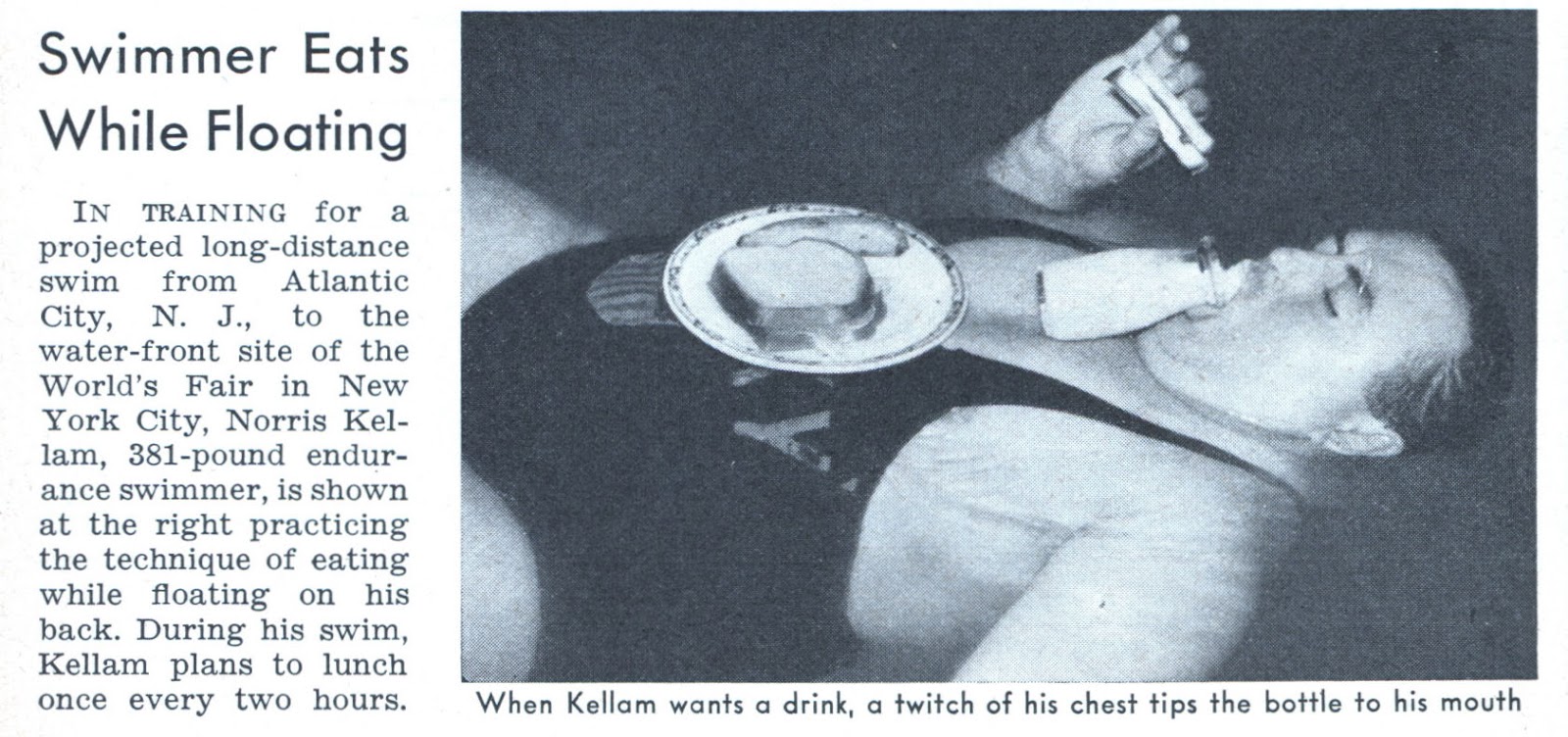

floating_eating.jpg
Well… except for this guy.  He’s got it figured out.  Wait!... Is that John Leonard? And is he wearing an illegal suit?!


During the height of the Atkins phase there were probably a lot of active people who jumped on board the low carb bandwagon and within a few weeks decided that it was a horrible idea for athletes.  This is due to two things:  first, when reducing carbohydrate we stop retaining the same amount of water, which means that we also flush electrolytes and can end up with flu-like symptoms if we do not manage this correctly; and second, there is an adaptation time that is required to start seeing the benefits of burning fat as your primary fuel. As a sugar-burner, I did not use fat as a fuel as efficiently, but now that I am a fat-burner I still have no problem burning sugar as fuel any time with no adaptation time required.  You see, there are changes that need to happen within the muscle, within cells, to be able to efficiently burn fat and ketones as fuel.  Reducing carbohydrate allows us to take better advantage of a higher level of metabolic flexibility.


Part of the problem with the currently accepted science regarding athletic nutrition is that when it comes to any studies that measure whether carbohydrate or fat is a better source of energy, fat tends to be set up to fail.  Studies can claim to be low carb while still allowing up to 30-50% of energy intake as carbohydrate (since the standard diet contains a ridiculous 70% carbs,) which does not allow for the metabolic switch to be flipped properly.  It can actually be a recipe for disaster in health since a diet that is both high carb and high fat has proven to be the best way to develop heart disease, especially when much of the fat in the standard American diet is from easily oxidized polyunsaturated vegetable oils or trans fats. Also, very few studies have been done that have allowed proper time to adapt and gain the metabolic flexibility to truly find the answers to many of the most important questions related to sports performance. Most of the studies out there would seem to imply that carbohydrates are not just a superior fuel, but that cutting them out is guaranteed to make performance suffer.  Unfortunately, the textbooks tend to agree.


Ad-icon-battle-Smokey-Bear-vs-perky-Flo-GQCBUS1-x-large.jpg
Smokey says: “Screw it.  Burn those stupid books.  They got it all wrong.”


Ever heard of Dr Tim Noakes?  He wrote a book called The Lore of Running and there are virtually zero serious runners out there who have never read it.  He was a world-class endurance runner in his day and is one of the leading researchers in athletics.  He is one of the guys who helped make “carbohydrate loading” a well known concept, among many other very important areas of research in which he has been a respected leader.  Recently, Dr. Noakes has taken some heat for changing his mind in a big way.  He is now telling people “If you’ve got Lore of Running, tear out the section on nutrition.”  He now endorses a low carb, high fat diet.   It takes a big man to admit you were wrong, but this guy followed modern research and came to the conclusion that we should all be eating fat rather than carbohydrate as our primary fuel, and as outlined in part 1 of my series, it is not just for sports.  It is for digestive, cardiovascular and neurological health as well.
Remember, moving anaerobic threshold and VO2 max up the hill has been the main focus of most traditional swim training for decades.  The majority of the work we have always done is in the EN1/2/3 boxes on the chart and is done with the hope of improving blood flow capacity and mitochondrial density.  Basically, we want to supply more fuel through efficient blood supply and provide more receptors through which to burn it.  Here are some additional details on VO2 max from sport-fitness advisor, and if you visit the website it links to additional sources as well:
The fitter an individual is to begin with, the less potential there is for an increase (in VO2 Max) and most elite athletes hit this peak early in their career. There also seems to be a genetic upper limit beyond which, further increases in either intensity or volume have no effect on aerobic power. This upper limit is thought to be reached within 8 to 18 months.
Crucially, once a plateau in VO2 max has been reached further improvements in performance are still seen with training. This is because the athlete is able to perform at a higher percentage of their VO2 max for prolonged periods. Two major reasons for this are improvements in anaerobic threshold and running economy.
So basically, once you hit your “genetic cap” for VO2 max, most improvements you see beyond that have more to do with technique efficiency and with being able to improve the anaerobic threshold to spend more time at an intensity level close to that max without locking up due to generating lactate above what you can clear.  This is important to understand in regard to training.  Basically, VO2 max is a measurement of potential, but anaerobic threshold tells us how much of that potential we can effectively apply to endurance racing.


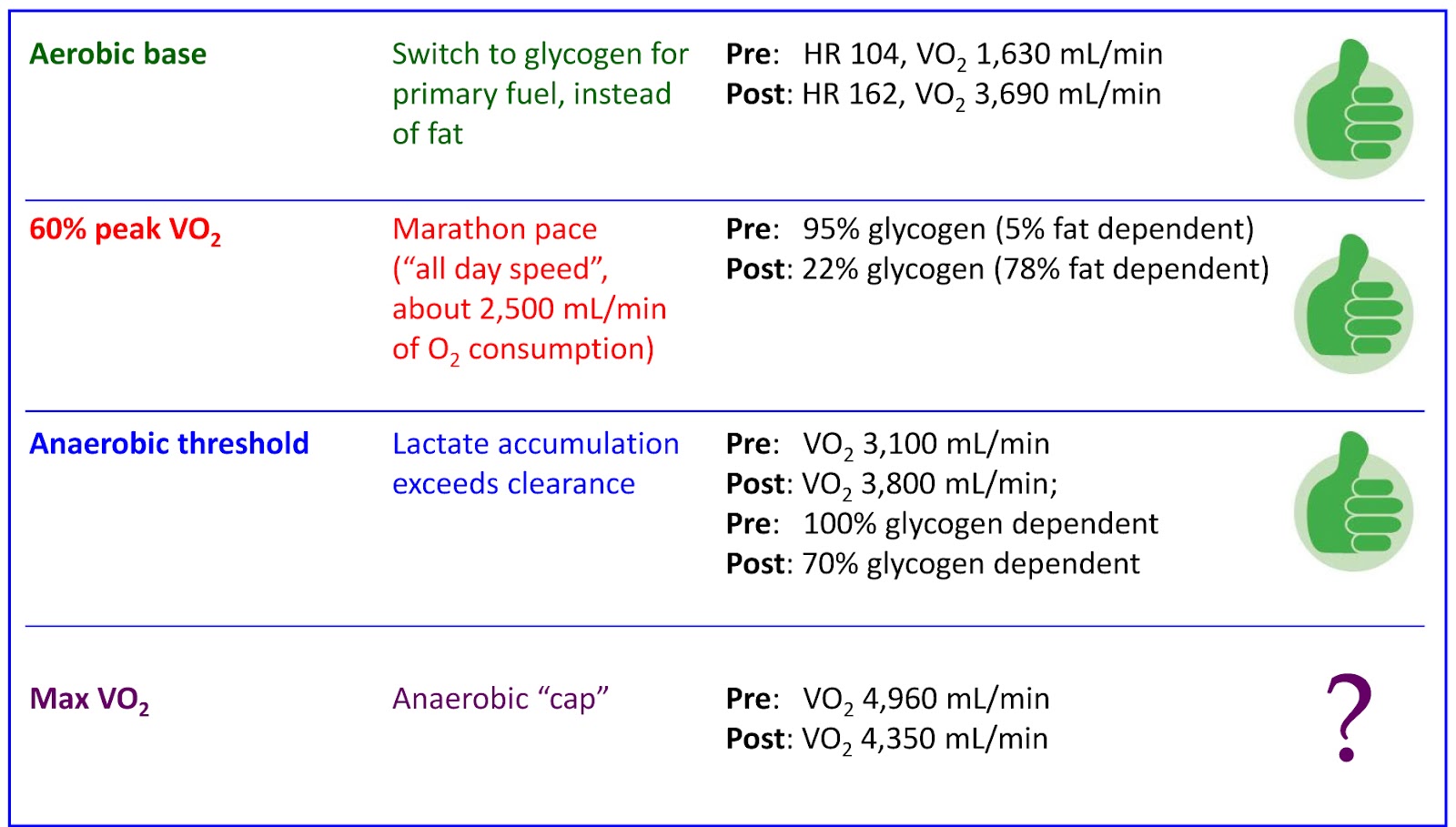
Remember Dr. Attia from above?  Well, when he started his blog, he posted this about the benefits he has seen since switching to a ketogenic diet.  Keep in mind, this is a doctor who was well-trained in endurance sports and had been meticulously tracking his stats before he switched his meal plan. This is not your mom trying her first “couch to 5k.” Note the improvements at the first three levels, which are the most pertinent to aerobic training in light of the information given above.

AttiaSummary1.jpg
Isn’t this the exact adaptation we should be focusing on?  These improvements are significant.  


Part of the reason for these advances might be that the ketogenic diet brings on a “glucose sparing” effect, meaning that even though a person might be training to prime their muscles to burn fat, and are probably storing less glycogen in the muscles and liver because of the carbohydrate restriction involved, we can use so much less glucose while racing that we still have it there for that max power at the end of the race when we need it.  To fully appreciate that this might be possible, I need to introduce you to the concept of Respiratory Quotient, or RQ.  I have cut and pasted the description from Dr Attia’s website, as I contend that this is quite possibly more important to endurance training than VO2 max:  


The respiratory quotient, or RQ, is simply the ratio of carbon dioxide you produce to oxygen you consume.  This ratio typically varies from about 0.70 to just over 1.00.  Why it’s important and helpful to know this ratio is that you can infer, based on the ratio, what you are utilizing for energy (i.e., how much fat versus glycogen) at any point in time during the test:
  • When RQ is 0.70 (i.e., when you breathing out 70% as much carbon dioxide as you are consuming oxygen), you are effectively getting all of your energy from fat.
  • When RQ is 1.00 (i.e., when you are breathing out an equal amount of carbon dioxide to the amount of oxygen you consume), you are effectively getting all of your energy from glycogen.
The goal of any endurance athlete is to derive as much energy as possible from fat, rather than glycogen, for a given level of exertion.  Why? We can store about 1,200 to 1,600 calories worth of glycogen versus 100,000 calories of fat.  Furthermore, replacing glycogen during training/competing is full of problems.  Hence, you want to “spare” glycogen for only those times when it is essential (i.e., when you are anaerobically active) and use fat as much as possible when you can afford to (i.e., when you are aerobically active).
The implications for improving our RQ score should seem obvious for distance swimming and endurance training, since relying less on glucose for work at the same intensity could be tremendously valuable.  This can help an athlete to work harder with less contribution from anaerobic glycolysis, and may have something to do with the claims of “never bonking,” better lactate clearance, and better recovery that many low-carb athletes swear by.   Take a look at Dr Attia’s chart again-- it is obvious that his aerobic capacity went up, and that he was generating the same power/intensity while using significantly less glucose. Essentially, he moved his anaerobic threshold, and can spend more time closer to his VO2 max, by manipulating his diet with no other changes.  Remember, he was already well-trained, and then made these improvements completely as a dietary experiment.


Dr. Attia gives us a great N=1 experiment, but other studies out there show that his increase in aerobic capacity and improved RQ are not an anomaly.  As a matter of fact, recent studies that have allowed for adaptation time and that have finally been done with well-trained athletes are confirming new benefits that long time low carbers have been bragging about for decades.  The science is slowly catching up.  The hardest part for me to swallow about all of this when I began following the evidence was that most of us swimmers are not ultra-endurance racers.  Improving low intensity endurance isn’t really that appealing to me as I don’t intend to ever race a mile again in my life-- and you couldn’t make me race a 10k even if it were to escape the zombie apocalypse.

35427dd2-c39a-4bf3-80da-51a2c24f2ab2.jpg
Yes, kids… this is why the Viking keeps a speedo clipped to his backpack. Never know when you are gonna need it.


For this to apply to us 1-2 minute racers, we would still have to be able to show that adaptation to a ketogenic diet will matter at much higher intensities, those that are owned by anaerobic glycolysis, or it just won’t apply to racing all that well. Right?


Enter the UCONN study.  Ben Greenfield is another self-experimenter.  He and a few other hardcore triathletes teamed up with a leading researcher, Dr Jeff Volek at the UCONN Human Performance Laboratory.  They decided to test a whole bunch of stuff to see what changed when extremely fit athletes were given at least 6 months to adapt to a ketogenic diet, which is much longer than most previous studies had ever done.  If you read part 1 and part 2 of Ben’s write up, you will see that they blew some of their stats off the charts.  The most important of those has to do with how quickly we can metabolize fat as a fuel during exercise.  


It has been standard thinking  for decades that fatty acids could only be burned at a maximum rate of about 1g/min.  That was with research done with athletes though, who were not adapted to the LCHF diet.  At that rate, even with the ability to generate so much ATP from fat versus the tiny amounts from glucose that I outlined in the last chapter of my manifesto, the trade off was not good compared to glucose which generates much less but at a much higher rate, unless of course you are only focusing on lower intensity activity.  The study at UCONN demonstrated that when well-trained athletes are given enough time to adapt to a ketogenic diet, that rate can improve to levels far beyond what we thought possible.  As a matter of fact, all of the athletes in the study were above 1g/min for the majority of the study, and some reached peak fat-burning above 1.5 times faster than what we previously thought was the maximum possible.  This is an incredible finding and has tremendous implications for endurance sports.  


So waitaminnit?!... you mean that we generate significantly more ATP from burning fats than we do from burning carbs, and by simply choosing to skip the hashbrowns when I order my steak and eggs I can make fat burn 50% faster?!  Yup.  That’s what I am saying.  Why in the hell would we want athletes in an endurance sport to be tethered to a carbohydrate burning system that is really only intended to help us with the kick at the end?  Yeah…  We have been doing it wrong for a long time, guys.  Follow the science.  Much more on this later.


ir1p8.jpg
Taking carb avoidance to it’s logical conclusion means that the Viking doesn’t even need to do dishes anymore.


To summarize:  there is evidence that the LCHF diet enhances some of the most important adaptations that swimmers strive to maximize during aerobic endurance training.  By priming the body to more efficiently use fat as a fuel for aerobic workload, we can generate more power aerobically, reduce the required contribution from anaerobic glycolysis, spare glycogen for later in a race where it can play a more important supplemental role, and tap into a nearly unlimited fuel tank of stored fat when compared to the small amount of glucose we are able to store in the liver and muscles.


Let that sink in for a bit… you’re gonna need to swallow that bite before I make my next post.  

Interesting Stats at Complete Nutrition

A couple of my athletes have been stopping by a place called Complete Nutrition lately, which seems to be a place that focuses on supplements and meal replacement products for the bodybuilding crowd.  Both of these athletes are beyond high school age and it is nice to see them taking an interest in nutrition.  They have been asking me a lot of questions and bringing up things they are learning as they read up on it.

I got curious about visiting the store because one of those swimmers has been checking in there to get detailed stats on his body composition.  He was actually able to tell me how much his body fat percentage had improved and exactly what his lean mass is.

So I stopped by the store and had mine evaluated.  Now, I can't make an argument for accuracy here, but the last time I had this done was during a school health fair where they bring in doctors and collect stats and hand out flyers for different programs they offer, but it was far enough into my LCHF diet that I had already lost the weight with running and weighed about 171 with around 10 or 11% body fat.  That would put my lean mass at approximately 154 pounds.

Since then (probably over a year) I feel like I look more fit but I had to go to Complete Nutrition to satisfy my curiosity.  The machine they have just requires you to take your shoes off, stand on some foot pads and hold onto a bar with sensors to press with your thumbs.  Apparently it determines your body composition based on electric currents somehow.  Sorry I don't know much about it.

I came away with a sheet that says I weigh 174.7, with 7.3% body fat and 161.8 pounds of lean mass.  This is very interesting to me as apparently I have gained 7 pounds of muscle while only gaining three pounds over-all.  And this is without lifting weights.  At age 40.

...and I keep getting faster too.  This morning after I completed a round of 100 breast targets USRPT style and scored 15+12+6, (a pretty good score considering I just moved my target time down about half a second not too long ago,) I took a 100 easy and then pushed my fastest 100 breast with-out a dive ever.  1:03.0.  Even better, I was out in 29.  For me, that's a big deal. I am feeling pretty good about the spring sectional meet coming up.  I have already seen significant improvements since the pro-am in December and I am pretty sure it will translate to better racing as long as I am healthy when I get there.


Wednesday, February 11, 2015

THE VIKING MANIFESTO Part 2: Energy Systems and Swim Training 101

THE VIKING MANIFESTO: Piecing Together a New Approach to Nutrition and Training for Swimmers from Scientific and Anecdotal Evidence.
Part 2:  Energy Systems and Swim Training 101

bugs-bunny-turtle-o.gif
Butter up that bacon and listen good… Viking is here to teach ya a little about fuel.

This post covers the three energy systems that contribute to the different intensities of athletic movement and how those relate to swim training.  I feel that while most coaches probably have a pretty good grasp on this topic, not all readers are coaches, and it never hurts to have a refresher.  Hopefully this helps us all to follow some of the ideas I am trying to get across throughout this multi-part series. Please understand that this is a simplified rundown on the complex science behind energy systems and training zones.  If you want more detail on the info I am summarizing here, there is more in-depth information available at the links throughout the article below. Much of the info here is cut, pasted and paraphrased from the links throughout the article.


All three energy systems basically boil down to different methods of making ATP available for muscle contraction, and it is a game of percentages, with each system contributing something all the time.  We never exclusively use one system as it is much more like a sliding scale based on intensity and substrate availability.  
  • First is the phosphagen system which gives you about 10 seconds of explosive power from the ATP and CP (creatine phosphate) stored within the muscles. We can’t store much, so even Vlad Morozov with a really good relay exchange couldn’t blast through a 50 free solely on the explosive energy this provides.  
  • Next in line is glycolysis.  It can contribute about 30 seconds to 2 minutes of all-out power based on available blood glucose and/or stored muscle glycogen.  This is the second fastest way to generate ATP, but for every glucose molecule broken down to pyruvate, only two molecules of useable ATP are produced.  The trade off is that when not enough oxygen is available, some of the pyruvate converts to lactate for energy. This is a fantastic source of power, but causes acidity which starts a cascade of events that interfere with muscle contraction.  It is anaerobic glycolysis that builds lactic acid.  When we reach the point that we are no longer able to clear lactic acid as quickly as we are producing it, we have passed our “anaerobic threshold” and will start seeing a diminished performance.
  • The aerobic system is more complex as it can use glucose, glycogen, and fats for oxidation.  The aerobic system can produce 36 molecules of ATP from glucose which is 18 times the contribution from glycolysis, but the hang up is that it is a much more slowly moving system.  The aerobic system can also produce a significantly higher amount from oxidation of fatty acids, with some fats shown to create up to 129 molecules of ATP per molecule of some specific types of fat.  This is why the aerobic system can keep you going through those long practices and events.  That is a lot of energy.  It’s too bad we can’t make fat metabolism work faster.  That could be a game changer, right?

Standard swimming training aims at increasing a few specific parameters, so most of our sets traditionally focus on these variables, in order from least intense to most intense: technique to develop hydrodynamic efficiency and propulsion, increasing anaerobic threshold, increasing VO2 max, increasing “lactate tolerance” and developing explosive power.  

ryan-lochte-600.jpg
...and ‘beefcakiness’.  Admit it.  This is why you swim.

Here is the standard chart most USA Swimming coaches tend to follow that guides set design based on these levels.  Please note that there is some cross-over between these levels and their intended adaptations. Sprinting and race-pace training are typically considered “lactate sets” in swimming, and these are the sets normally designed to improve lactate tolerance, which includes mainly SP 1-2 but depending on the design of the set this can also be part of the equation in the higher EN 2 and 3 categories as well. The higher intensity work like speed play, ultra-short sprints, dynamic start/turn work and using the power-rack would be included in the SP3 category, designed to train the creatine-phosphate contribution to racing.

Long, low intensity endurance training has been the meat and potatoes of swim training for decades due to it’s effect on improving oxygen delivery and uptake to muscles.  This is primarily based on adaptive increases in blood flow capacity and mitochondrial density, thus increasing oxygen delivery to muscle and oxygen metabolism within the muscle, thus enhancing our ability race well, while relying less on anaerobic glycoysis. This defines aerobic training in swimming and is directly tied to improving anaerobic threshold and VO2 max in some way at all of the REC, EN1 and EN2-3 intensity levels.  VO2 max measurement has been accepted as defining the limits of the cardiorespiratory system, and obviously increasing your ability to generate power from oxygen would boost swimming performance.  

There is of course a lot more detail behind these processes but we aren’t really pursuing a chemistry or biology degree here.  I just hope that if you find any of the points I plan to make in following points confuse you, that you will come back here to have a reference to help make sense of it when it starts getting detailed.  My next post is about potential modern advances in aerobic training.  I hope you stay tuned and that I can make this easy enough to follow along.

homer taking notes.JPG


Monday, February 9, 2015

THE VIKING MANIFESTO Part 1: The New Science of Healthy Eating

THE VIKING MANIFESTO: Piecing Together a New Approach to Nutrition and Training for Swimmers from Scientific and Anecdotal Evidence.
Part 1:  The New Science of Healthy Eating


Nutrition can often be like politics and religion. People tend to dig their heels in and stand up for their long held beliefs even in the face of evidence to the contrary. Sometimes they don’t even know how they first formed those beliefs. Unfortunately in America, when it comes to nutrition, much of our base knowledge stems from advertising.  

Feel free to add nutrition to the list of things you shouldn't talk about when you're drunk. I am not drunk right now but you might think I am when you hear me out. I came here to tell you that the standard nutrition advice you have heard all your life might just be completely wrong. The 60-70% carbohydrate, low-fat ideal is something that I have hardly heard anyone question in my thirty years of swimming, so I am taking it on with a few posts at SwimSwam along with more at the blog I share with Chris DeSantis, The Swim Brief.  A lot of what I will have to say here will be speculation based on things I have read, but all I can ask is that you follow along and form your own opinion as we go. I understand that I am not a world-class swimmer and I would qualify as merely a mediocre high school and club coach at best so it is hard to consider me any kind of an expert.  I also understand that I am not a nutritionist, and I am aware that many of the links I will direct you to are blogs and such, but if you follow them you will find all the science you need.  I can also direct you to more if you have questions.  This has become a passion of mine, as it was the launching pad for an unexpected and surprisingly successful comeback to swimming in my forties that would not have happened if I had never changed my relationship with food. I hope you can keep an open mind and follow me as I present the other side of the story regarding advances in the science of training and nutrition.


I have always felt there was some sort of disconnect between the advice I was given in my exercise physiology and nutrition courses while pursuing my degree and what would be truly optimal for me as a swimmer. I remember being frustrated that most of the studies referred to in the textbooks were done on marathon runners or power-lifters, with us 1-2 minute racers in the middle being ignored.  I was genuinely interested in the science and wanted someone smarter than me to just tell me what to do.  I was the kid who liked reading the textbook even when it wasn’t assigned. I remember being a little uneasy when we were told to keep our blood sugar high to enhance performance, and to eat small snacks often or have sugary sports drinks to avoid dips in energy, partly because most of that advice came from studies done at the Gatorade institute which seemed to be a conflict of interest, and also because that advice seemed to work horribly for me.  Carb loading and sipping Gatorade made me feel awful. The “carb-carb-carb-gotta-keep-blood-sugar-up” plan backfired on me more often than not. The first meet where my school provided Powerade on deck was the worst shave meet I had in four years of college-- but who was I to question science, right? I was a twenty year old kid with a mohawk.  I looked pretty stupid trying to argue with a professor who used to run marathons.  I still remember going to a doctor about my unreasonable fatigue and being told I need to “choose better carbs” and eat them more often, as though they just assumed I was eating skittles for most of my calories.  


Come to think of it, carb loading at the Mo State swimmer house did get a little out of hand...

So imagine my surprise when at age 38 I stumbled upon the concept of ketones as a legitimate energy source. Suddenly I felt as though I had been lied to about food all my life, and the more I researched, the more that feeling reached conspiracy-theory levels. Ketones were hardly mentioned in my degree program.  They were presented as an inefficient fuel created by breaking down fatty acids during starvation to help us get by. So then why are there so many runners, cyclists, triathletes, and power lifters out there on the web claiming that ketones are a super fuel that keeps them from bonking on ultra-endurance races, promotes better recovery from workouts, and are starting to become the basis of treatments for several chronic diseases?  Huh?

Here's how it works. A normal, healthy metabolism will typically produce a small amount of ketones overnight or any time you fast. Some people, if they knew this, might freak out thinking this could be dangerous considering the problems that can be associated with low blood sugar and the fact that one of the worst complications from diabetes is called ketoacidosis, which is often confused with nutritional ketosis. Ketones are a natural energy source from burning fat. If you lose a few pounds of body fat your ketones have been elevated-- no question. The problem is that we gradually lose the ability to do this efficiently as we become insulin resistant.  Insulin can block our access to fats for fuel and stands in the way of ketogenesis, so essentially, when our blood sugar is up, our fat burning ability is turned down. This is a safety mechanism:  we have to burn glucose in the bloodstream first since high levels can be toxic, therefore fat tends to be stored when glucose is freely available in high amounts.  If we become insulin resistant, our blood sugar and insulin levels are chronically high which leads to many complications over time. Insulin resistance is strongly correlated with metabolic syndrome. The weight you gain as you age, even though you might feel you are eating healthy, is not necessarily normal. It is often tied to the level of insulin resistance you have developed over the years, and when that becomes strong enough, you are on the edge of diabetes.  There is a clinic at Duke that treats obesity and diabetessimply by replacing medication with a ketogenic diet, which flies in the face of our medical industry's standard treatment but has had tremendous success.  And oh yeah, did I mention that the ketogenic diet has also been known as a treatment for epilepsy for over a hundred years and is now being seriously studied as a potential treatment option in a wide range of ailments from Alzheimer’s to cancer?  There are numerous health benefits that come with removing carbohydrate from our diets and increasing our fat intake, and ketones are now being researched as an anti-aging mechanism.  My stomach issues (among other things,) cleared up immediately after dropping carbohydrate from my diet, and I now wake up at 5am ready to rock every day rather than suffering my way out of bed--, but hey, maybe it's the 35 pounds I lost that are just making me think I feel better, right?

But what about your heart, Viking?  Won't it explode if we get rid of whole grains and add fat?  You might as well attach a rocket to your cholesterol numbers, right?! Well, in the next few years you are going to see more articles like this one, and this one, almost apologizing for getting it completely wrong over the last few decades. If you follow the most recent science you will see saturated fats and cholesterol being vindicated, with sugars and other carbohydrates now being blamed for heart disease. The tide is turning and it is fascinating to watch. Old science, food politics and our food and medical industries are being taken to task by a more informed public. The cascade of problems above, many of them accelerated by our obsession with sugary drinks and other sources of high or hidden fructose, is also the reason we now have children with Type 2 Diabetes even though it was once called “Adult Onset Diabetes” and is also why we now have children turning up with Fatty Liver Disease like an alcoholic.  Fructose is primarily processed in the liver, which is why it tends to have a higher correlation with diabetes and with the creation of visceral fat.  Fructose is a much greater contributing factor to heart disease than saturated fats and cholesterol, but don’t try telling the American Heart Association that.

Check out this great exchange between a columnist and a spokesman for the AHA.  Situations like this are the reason Max Planck once said “Science progresses one funeral at a time.”  Add money to that mix and you can imagine why it might take a few more funerals to get our political, education, food, pharmaceutical and medical industries on board with a new approach to healthy eating.

Eating fat doesn’t make you fat-- apparently it makes you fast.

I get approximately 75 percent of my calories from fat, mostly saturated, and eat no grains whatsoever.  My cholesterol did go up, but I am not worried about heart disease and neither is my doctor.  Studies have shown that most people who switch to low carb move to more favorable lipid profiles, and for people like me whose cholesterol goes up, it is usually a short-term side effect.  Cholesterol is considered one risk factor for heart disease, and it is not necessarily a risk factor in and of itself. As a matter of fact, it was recently shown that in the elderly, higher LDL scores are correlated with lower all-cause mortality. Oxidized LDL is proving to be the problem, and if we avoid the most easily oxidized fats and reduce inflammation we reduce risk.  Here is a great blog from a heart doctor who switched to a paleo diet and happened upon something that urges new studies to be done.  He has excellent N=1 evidence that even with a high LDL particle count, which is considered a dangerous indicator, scans show that his levels of arterial thickness might have reversed.  The significance here is that the medical establishment doesn't really believe this can happen.  It is accepted that build up in the arteries is cumulative and does not reverse itself.  This doctor seems to think that this diet that pulls fat from cells so efficiently might also pull it from the walls of arteries in the same way.  If that is true, we might be on to something that could change our entire medical system.


We have sciency stuff that needs to be done.  Anybody got this guy’s number?

If you want to read more about this stuff, I can recommend all sorts of great links.  Watch for more to come at SwimSwam and feel free to save http://www.swimbrief.net in your favorites to check in there once in a while as well. The rabbit hole is deep on this topic.  My swimming comeback has really been a fantastic journey of self-experimentation and thorough investigation and I want to share a whole new world of nutrition knowledge with all of you, my friends in swimming.

My next post will be a brief review of some of the science that we coaches learn early on in our careers to help lay a foundation for future posts, where I will sum up why I believe the low-carb high-fat diet is not just a healthy option for the average Joe.  I believe LCHF is the way we Homo Sapiens were designed to eat, and I think I can make a great argument about why it is also optimal for swimmers.  Even more, I will argue that because of the specific metabolic adaptations related to LCHF, there is also an optimal way to train and prepare for races. Please stay tuned and I of course, encourage comments.


**Yes, this was written for SwimSwam but I am actually posting on both sites with their permission.  :)


Wednesday, January 28, 2015

Sneaking in a Workout, Ended Up with a Flashback

Yesterday I took my high school girls to a meet and had a chance to sneak in a workout during the diving warm-up.  It was simple and short, of course, but no different than my normal.

My 200 breast USRPT target doesn't quite match my best time right now.  Notice, when I started this training I was at 2:12.3 for my best come-back race time, which translates to a 33.0 target.  I decided to leave my target there even after I improved since I had not mastered it yet by completing 20 repeats with no fails.

-8x75 warm up, mixing in speedplay.
-50's on 50 at 200 breast USRPT target (33.08) out to third fail.  My score was 8+2+2.  (My previous best is 11-4-2.)
-150 easy...

Since I didn't do my best score I decided to try to redeem it by doing a fast 200 breast from a push.  My best in a practice so far was 2:21, which I had done once.  Before that I had done a couple of 2:24's after target sets and I was hoping to take a shot at that 2:21 again.

Well, when I got to the 75, who did I see?  My old college coach from Missouri State, Jack Steck, standing at the end of the lane watching. He had showed up to officiate the high school meet.  He had his shoulders shrugged and a hand on his chin as though he was about to get on my case for something... so of course I dug deep.  I ended up hitting a 2:17.

It hurt like hell, but it was a great feeling having Jack watching me as though he was calculating how many points I was about to score.  It certainly added something to the workout.

Not sure I could handle that every day though. USRPT is mentally tough enough without Jack breathing down my neck. I felt like I was gonna die when I hit that wall!

Dammit, Klosterman!  You're swimming like you just got your ass bit by a Saluki!